
Car Insurance When Moving to Delaware
Free to compare
The 60-Day Window and the Coverage Gap
You moved to Delaware last week with a sedan and an SUV, both insured under your previous state's policy. You know Delaware gives new residents 60 days to register vehicles and obtain Delaware insurance, but you assumed your out-of-state coverage would bridge that window. It often does not. Many carriers cancel or non-renew the moment you establish residency in a new state, leaving both vehicles uninsured before you realize the policy lapsed.
Delaware law requires new residents to register vehicles and obtain Delaware liability insurance within 60 days of establishing residency. The state defines residency as the point you take a job, enroll children in school, register to vote, or spend more than 183 days in Delaware during a calendar year. Your out-of-state carrier may interpret residency differently and cancel coverage the day you notify them of the move, or the day they discover the address change through a claim or renewal audit. Households with multiple vehicles face the same 60-day deadline for every car, and a lapse on one vehicle can trigger a registration suspension for all.
“Most carriers cancel your out-of-state policy the day you establish Delaware residency, not 60 days later when you register the vehicles.”
Meet Delaware's Requirements Without Overpaying
Get My Delaware Car Insurance Quote$25,000 / $50,000 / $10,000
Delaware Minimum Liability Limits
Delaware requires $25,000 bodily injury per person, $50,000 bodily injury per accident, and $10,000 property damage. Personal injury protection is mandatory. Every vehicle registered in Delaware must carry proof of these minimums.
Delaware Division of Motor Vehicles
What Happens to Your Out-of-State Policy
Your out-of-state policy was written for the state you left. Delaware requires different minimums, different mandatory coverages, and different proof-of-insurance rules. Most carriers will not simply transfer your existing policy to Delaware; they cancel the old policy and issue a new one under Delaware rules, or they non-renew at the next term if you moved mid-term.
The structural problem: cancellation timing. If your carrier cancels the out-of-state policy the day you establish residency but you do not secure Delaware coverage until you register the vehicles 30 days later, both cars sit uninsured for a month. If you file a claim during that gap, the carrier denies it. If a Delaware police officer stops you during that gap, you face fines and potential registration suspension.
Some carriers write policies in multiple states and will transfer your coverage administratively, keeping both vehicles insured under a single policy number while updating the garaging address and state-specific endorsements. This is the exception. Most households moving to Delaware with multiple vehicles must close the out-of-state policy and open a new Delaware policy, coordinating the effective dates so no gap appears between the two.

Your out-of-state carrier often cancels coverage the moment you establish Delaware residency, not 60 days later when you register the vehicles.
Related Articles



Combining Vehicles on One Delaware Policy
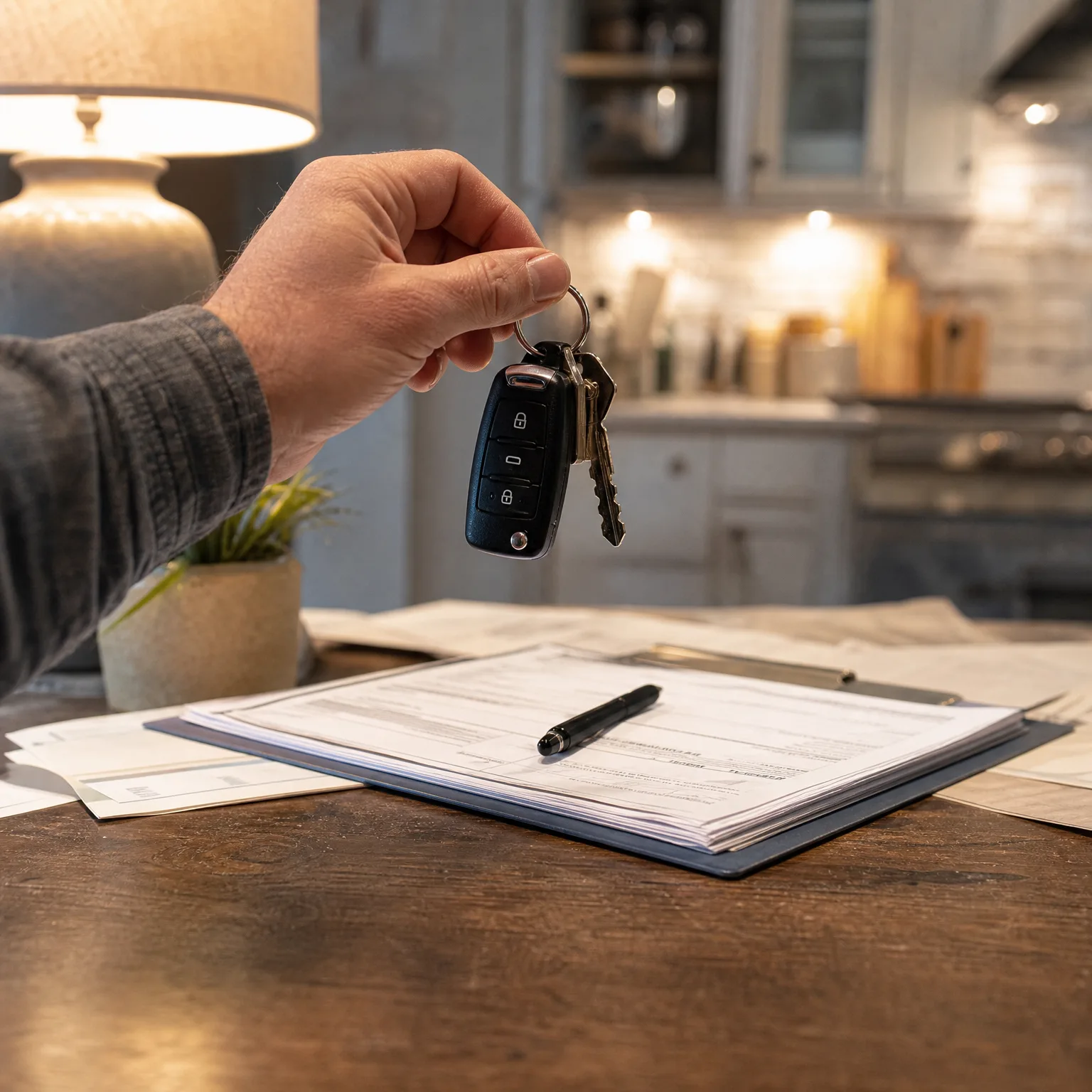
Delaware carriers offer multi-car discounts when every vehicle in the household sits on the same policy. The discount structure varies by carrier, but the requirement is universal: every car must be titled to a member of the same household, garaged at the same Delaware address, and listed on the same policy. If you moved to Delaware with your spouse and each of you carried a separate policy in your previous state, combining both vehicles onto one Delaware policy typically lowers the total premium compared to maintaining two separate Delaware policies.
The structural blocker: vehicle titling and household composition. If one vehicle is titled to a household member who is not listed as a driver on the policy, or if one vehicle is garaged at a different Delaware address, the multi-car discount may not apply. Delaware carriers verify garaging address and driver assignment at the time of the quote. If you plan to combine three vehicles onto one policy but one car will be garaged at a college campus in another state while your child attends school, that vehicle may need its own policy or may be excluded from the multi-car discount depending on the carrier's rules.
Request quotes that include every vehicle and every driver in the household. Compare the combined-policy premium to the sum of separate policies. In most cases, the combined policy costs less, but not always. A household with one high-risk driver and two standard-risk drivers may see a lower total premium by placing the high-risk driver on a separate non-standard policy and the other two drivers on a preferred-tier policy. Delaware carriers writing non-standard auto insurance include Dairyland, Direct Auto, The General, and National General. Standard and preferred carriers include State Farm, Geico, Progressive, Allstate, and Farmers.
17.6%
Delaware Uninsured Motorist Rate
17.6% of Delaware motorists drive without insurance. Uninsured motorist coverage is optional in Delaware but protects households with multiple vehicles when an at-fault driver has no insurance. Consider adding it when combining vehicles on one policy.
Insurance Research Council, 2023
Delaware-Specific Coverage Requirements
Delaware requires personal injury protection on every auto insurance policy. PIP pays medical expenses and lost wages for you and your passengers regardless of fault, up to the policy limit. Households moving from states without mandatory PIP often see higher premiums in Delaware because PIP adds cost to every policy. You cannot waive PIP in Delaware unless you meet specific health-insurance-coverage criteria, and most households do not qualify for the waiver.
Uninsured motorist coverage is optional in Delaware but recommended. 17.6% of Delaware drivers have no insurance. If an uninsured driver hits one of your vehicles, uninsured motorist coverage pays for your injuries and vehicle damage up to your policy limits. Delaware carriers offer uninsured motorist coverage in the same limit structure as liability: per person, per accident, and property damage. Adding uninsured motorist coverage to a multi-car policy increases the premium, but the increase is smaller than the cost of repairing two vehicles out of pocket after an uninsured driver causes a crash.
Registration and Proof of Insurance
Delaware requires proof of insurance before you can register a vehicle. The DMV verifies insurance electronically for most carriers. If your carrier does not participate in the electronic verification system, you must present a paper insurance card or a digital proof-of-insurance document at the DMV office. The document must show the vehicle identification number, the policy effective date, the coverage limits, and the policyholder name. If you are registering three vehicles on the same day, bring proof of insurance for all three.
If you miss the 60-day deadline, Delaware assesses a late fee and may suspend your driver license until you complete registration and provide proof of insurance. A suspended license blocks vehicle registration for every car in the household, not just the one that triggered the suspension.
Compare Carriers and Secure Coverage Now
Request quotes from at least three Delaware carriers that write multi-car policies. State Farm, Geico, Progressive, Allstate, Farmers, Nationwide, and Travelers all write standard auto insurance in Delaware and offer multi-car discounts. If one driver in your household has a recent violation or a lapse in prior coverage, request quotes from Dairyland, Direct Auto, The General, and National General as well. Compare the combined-policy premium to separate policies for each vehicle. Verify that the effective date of the new Delaware policy aligns with the cancellation date of your out-of-state policy so no gap appears. Once you secure Delaware coverage, complete vehicle registration within the 60-day window to avoid late fees and license suspension.
How to Transfer Multiple Vehicles Without a Gap
Contact your out-of-state carrier within the first week of the move. Ask whether the policy will remain in force until you cancel it, or whether the carrier will cancel it automatically when you notify them of the Delaware address. If the carrier cancels automatically, note the cancellation date. If the policy remains in force until you request cancellation, you control the timing. Request quotes from Delaware carriers immediately, naming every vehicle you will register in Delaware and every driver in the household. Delaware requires personal injury protection on every policy, and many households moving from states without PIP see higher premiums than expected.
Set the effective date of the new Delaware policy to match the cancellation date of the out-of-state policy. If your out-of-state carrier cancels on March 15, the Delaware policy must begin March 15. If you control the cancellation timing, schedule it for the day the Delaware policy starts. Do not leave a gap. Do not overlap policies for more than a day unless the out-of-state carrier refunds the unused premium; most do, but confirm before paying twice. Once the Delaware policy is active, notify the Delaware Division of Motor Vehicles and complete vehicle registration within the 60-day window. The DMV will verify insurance electronically for most carriers.
Get Your Free Quote
Get My Delaware Car Insurance QuoteFrequently Asked Questions
Can I keep my out-of-state insurance after moving to Delaware?
No. Delaware requires new residents to obtain Delaware insurance within 60 days of establishing residency. Most out-of-state carriers cancel your policy when you notify them of the move or when they discover the address change. You must secure Delaware coverage before the out-of-state policy cancels to avoid a gap.
Do I need separate policies for each vehicle when I move to Delaware?
No. Delaware carriers offer multi-car discounts when every vehicle in your household sits on the same policy. Combining vehicles on one policy typically costs less than maintaining separate policies. Every car must be garaged at the same Delaware address and titled to a household member listed on the policy.
What happens if I register my vehicles late in Delaware?
Delaware assesses a late fee and may suspend your driver license if you miss the 60-day registration deadline.
Is personal injury protection required in Delaware?
Yes. Delaware requires personal injury protection on every auto insurance policy. PIP pays medical expenses and lost wages regardless of fault. You cannot waive PIP unless you meet specific health-insurance-coverage criteria.
How do I prove insurance when registering multiple vehicles in Delaware?
The Delaware DMV verifies insurance electronically for most carriers. If your carrier does not participate, bring a paper insurance card or digital proof-of-insurance document for each vehicle. The document must show the VIN, policy effective date, coverage limits, and policyholder name.